Jesse's Teahouse
Couldn't load pickup availability
What is a Red Pu’er?

Pu’er tea is the specialty of Yunnan China, where it is collected and aged like wine, and where each mountain’s specific balance of sweetness, astringency, and energizing “cha qi” tea energy is well known.
This tea is a raw (sheng) pu’er with a red tea fermentation step added. Normal raw pu’er is made by picking and withering the leaves, then rolling them and heat-fixing them in a wok, and allowing them to sun-dry.
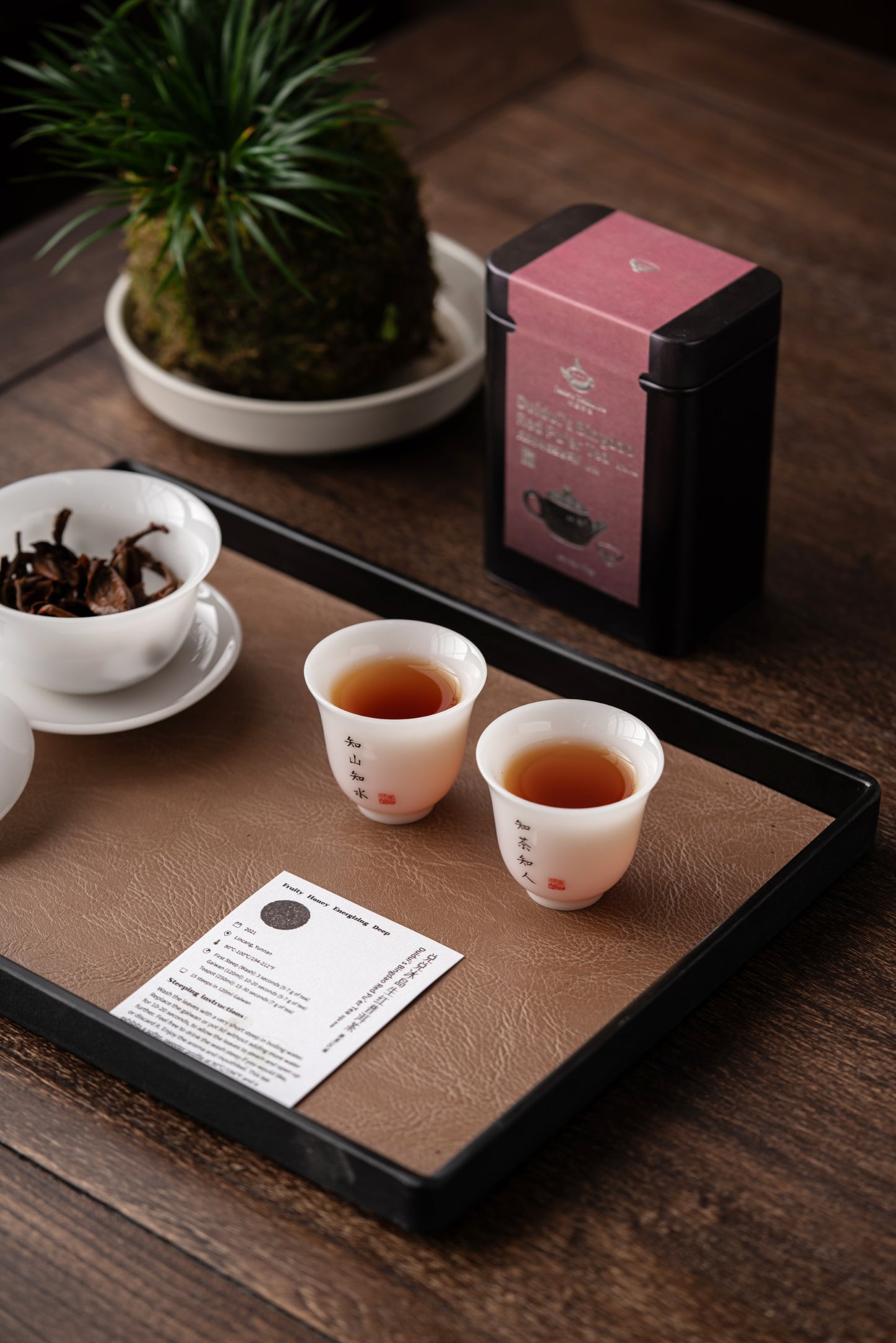
This red pu’er combines traditional pu’er production techniques alongside an added red tea fermentation step. The result is a super bold, rich, energetic, sweet and malty tea that still boasts a gentle astringency and complex aftertaste.
Beyond the technique, the Bingdao tea region is considered one of the best tea regions in the world, and this tea is a chance to try a top-tier tea region’s tea in a small size.
Who’s Dui Dui?
The man, the myth, the legend: Duidui is Jesse’s tea guy and friend of 14 years.

Duidui has been doing Yunnan tea for over 30 years. Before the Bingdao and Laobanzhang areas became famous all over China, Duidui had already secured his own tea gardens and has spent the last three decades managing his trees, his production process, and his own fermentation areas in Menghai.
He develops relatively few products, instead focusing on quality, simplicity, and constant improvement of the tea types he makes. He also makes tea pots and cups the same way, constantly refining his materials and techniques, and making only a few items.
Duidui’s other teas on the website have all become favorites of new drinkers and experienced tea people alike.
Fans of the Teahouse know: Duidui only makes bangers.
Duidui and Jesse discuss Shou Pu’er Fermentation
What is Bingdao & Dijie Region?
Jesse Says:
Bingdao is a village deep in the forests of Xishuangbanna, where the terroir is so perfectly suited to the growth of the tea tree that wild trees from this area yield the most expensive tea in all of China. Pu’er from the most central, ancient trees can go for thousands of dollars for a single tea cake. Aged Bingdao tea is even more valuable.
Because of this, there is a lot of “fake” Bingdao tea on the market. People have even accused me of selling “fake” Bingdao tea on the internet. This time, to make sure that people know they’re getting the real deal, I want to spell out all the details here so people know what they’re getting.
Duidui has a tea farm in the Dijie area of Bingdao. This is a few kilometers from the most valuable central area, but because Duidui has had these trees for decades and has managed it himself for a long time, we are certain that the tea is indeed from Bingdao.
Why isn’t it thousands of dollars? Well:
- The trees aren’t hundreds of years old;
- They’re a bit back from the core area, and
- Duidui is a good friend of mine and a total boss and gave us a deal.
Also, the red tea fermentation technique being done properly is very important, and if done well, red tea of top quality can be produced with low-to-mid-tier leaves. Of course, these are “low tier” leaves from the perspective of the most expensive tea region in the world – all the leaves there benefit from the top-tier terroir.
I took the picture of his farm myself, having personally visited the village of Bingdao with Duidui and seen his trees. If you want some Bingdao-region tea without going there yourself, this tea is a great choice.

Two Sizes: 50g Tins & 300g Cakes
Because Duidui’s teas have such great support amongst our community, we’ve assumed people will want full cakes already and also have this item available as a 300g cake.
Select the size by using the drop-down menu at the top of the item page.
If you like Duidui’s stuff, try the rest of Duidui’s tea and tea equipment by searching “Duidui” in the search bar at the top of the page.
NOT JUST TEA, TEA CULTURE
Jesse believes the key to making good tea is to help his Chinese tea friends share not just their best teas, but the best ways to make the teas.
That's why each box comes also comes with an info card that tells you:
- Tea Origin
- Steep Temperature
- Steep Time
- Directions for both teapot steeping and gaiwan steeping
All Jesse’s Teahouse Tea Friends (that’s you now!) also get access to private YouTube videos where Jesse and his Chinese tea friends show you how to make the teas and explain the tea-making process.
The links are on QR codes on the back of the info card included in the tea box.
Don't Forget Your Tea Pets!
In Chinese Gongfu Tea Tradition, Tea Pets accompany you at teatime and you "raise" them by feeding them tea! Don't forget to check the tea pet page before you go!
What is a Red Pu’er?
Pu’er tea is the specialty of Yunnan China, where it is collected and aged like wine, and where each mountain’s specific balance of sweetness, astringency, and energizing “cha qi” tea energy is well known.
This tea is a raw (sheng) pu’er with a red tea fermentation step added. Normal raw pu’er is made by picking and withering the leaves, then rolling them and heat-fixing them in a wok, and allowing them to sun-dry.
This red pu’er combines traditional pu’er production techniques alongside an added red tea fermentation step. The result is a super bold, rich, energetic, sweet and malty tea that still boasts a gentle astringency and complex aftertaste.
Beyond the technique, the Bingdao tea region is considered one of the best tea regions in the world, and this tea is a chance to try a top-tier tea region’s tea in a small size.
Who’s Dui Dui?
The man, the myth, the legend: Duidui is Jesse’s tea guy and friend of 14 years.
Duidui has been doing Yunnan tea for over 30 years. Before the Bingdao and Laobanzhang areas became famous all over China, Duidui had already secured his own tea gardens and has spent the last three decades managing his trees, his production process, and his own fermentation areas in Menghai.
He develops relatively few products, instead focusing on quality, simplicity, and constant improvement of the tea types he makes. He also makes tea pots and cups the same way, constantly refining his materials and techniques, and making only a few items.
Duidui’s other teas on the website have all become favorites of new drinkers and experienced tea people alike.
Fans of the Teahouse know: Duidui only makes bangers.
Duidui and Jesse discuss Shou Pu’er Fermentation
What is Bingdao & Dijie Region?
Jesse Says:
Bingdao is a village deep in the forests of Xishuangbanna, where the terroir is so perfectly suited to the growth of the tea tree that wild trees from this area yield the most expensive tea in all of China. Pu’er from the most central, ancient trees can go for thousands of dollars for a single tea cake. Aged Bingdao tea is even more valuable.
Because of this, there is a lot of “fake” Bingdao tea on the market. People have even accused me of selling “fake” Bingdao tea on the internet. This time, to make sure that people know they’re getting the real deal, I want to spell out all the details here so people know what they’re getting.
Duidui has a tea farm in the Dijie area of Bingdao. This is a few kilometers from the most valuable central area, but because Duidui has had these trees for decades and has managed it himself for a long time, we are certain that the tea is indeed from Bingdao.
Why isn’t it thousands of dollars? Well:
- The trees aren’t hundreds of years old;
- They’re a bit back from the core area, and
- Duidui is a good friend of mine and a total boss and gave us a deal.
Also, the red tea fermentation technique being done properly is very important, and if done well, red tea of top quality can be produced with low-to-mid-tier leaves. Of course, these are “low tier” leaves from the perspective of the most expensive tea region in the world – all the leaves there benefit from the top-tier terroir.
I took the picture of his farm myself, having personally visited the village of Bingdao with Duidui and seen his trees. If you want some Bingdao-region tea without going there yourself, this tea is a great choice.
Two Sizes: 50g Tins & 300g Cakes
Because Duidui’s teas have such great support amongst our community, we’ve assumed people will want full cakes already and also have this item available as a 300g cake.
Select the size by using the drop-down menu at the top of the item page.
If you like Duidui’s stuff, try the rest of Duidui’s tea and tea equipment by searching “Duidui” in the search bar at the top of the page.
NOT JUST TEA, TEA CULTURE
Jesse believes the key to making good tea is to help his Chinese tea friends share not just their best teas, but the best ways to make the teas.
That's why each box comes also comes with an info card that tells you:
- Tea Origin
- Steep Temperature
- Steep Time
- Directions for both teapot steeping and gaiwan steeping
All Jesse’s Teahouse Tea Friends (that’s you now!) also get access to private YouTube videos where Jesse and his Chinese tea friends show you how to make the teas and explain the tea-making process.
The links are on QR codes on the back of the info card included in the tea box.
Don't Forget Your Tea Pets!
In Chinese Gongfu Tea Tradition, Tea Pets accompany you at teatime and you "raise" them by feeding them tea! Don't forget to check the tea pet page before you go!
What is a Red Pu’er?
Pu’er tea is the specialty of Yunnan China, where it is collected and aged like wine, and where each mountain’s specific balance of sweetness, astringency, and energizing “cha qi” tea energy is well known.
This tea is a raw (sheng) pu’er with a red tea fermentation step added. Normal raw pu’er is made by picking and withering the leaves, then rolling them and heat-fixing them in a wok, and allowing them to sun-dry.
This red pu’er combines traditional pu’er production techniques alongside an added red tea fermentation step. The result is a super bold, rich, energetic, sweet and malty tea that still boasts a gentle astringency and complex aftertaste.
Beyond the technique, the Bingdao tea region is considered one of the best tea regions in the world, and this tea is a chance to try a top-tier tea region’s tea in a small size.
Who’s Dui Dui?
The man, the myth, the legend: Duidui is Jesse’s tea guy and friend of 14 years.
Duidui has been doing Yunnan tea for over 30 years. Before the Bingdao and Laobanzhang areas became famous all over China, Duidui had already secured his own tea gardens and has spent the last three decades managing his trees, his production process, and his own fermentation areas in Menghai.
He develops relatively few products, instead focusing on quality, simplicity, and constant improvement of the tea types he makes. He also makes tea pots and cups the same way, constantly refining his materials and techniques, and making only a few items.
Duidui’s other teas on the website have all become favorites of new drinkers and experienced tea people alike.
Fans of the Teahouse know: Duidui only makes bangers.
Duidui and Jesse discuss Shou Pu’er Fermentation
What is Bingdao & Dijie Region?
Jesse Says:
Bingdao is a village deep in the forests of Xishuangbanna, where the terroir is so perfectly suited to the growth of the tea tree that wild trees from this area yield the most expensive tea in all of China. Pu’er from the most central, ancient trees can go for thousands of dollars for a single tea cake. Aged Bingdao tea is even more valuable.
Because of this, there is a lot of “fake” Bingdao tea on the market. People have even accused me of selling “fake” Bingdao tea on the internet. This time, to make sure that people know they’re getting the real deal, I want to spell out all the details here so people know what they’re getting.
Duidui has a tea farm in the Dijie area of Bingdao. This is a few kilometers from the most valuable central area, but because Duidui has had these trees for decades and has managed it himself for a long time, we are certain that the tea is indeed from Bingdao.
Why isn’t it thousands of dollars? Well:
- The trees aren’t hundreds of years old;
- They’re a bit back from the core area, and
- Duidui is a good friend of mine and a total boss and gave us a deal.
Also, the red tea fermentation technique being done properly is very important, and if done well, red tea of top quality can be produced with low-to-mid-tier leaves. Of course, these are “low tier” leaves from the perspective of the most expensive tea region in the world – all the leaves there benefit from the top-tier terroir.
I took the picture of his farm myself, having personally visited the village of Bingdao with Duidui and seen his trees. If you want some Bingdao-region tea without going there yourself, this tea is a great choice.
Two Sizes: 50g Tins & 300g Cakes
Because Duidui’s teas have such great support amongst our community, we’ve assumed people will want full cakes already and also have this item available as a 300g cake.
Select the size by using the drop-down menu at the top of the item page.
If you like Duidui’s stuff, try the rest of Duidui’s tea and tea equipment by searching “Duidui” in the search bar at the top of the page.
NOT JUST TEA, TEA CULTURE
Jesse believes the key to making good tea is to help his Chinese tea friends share not just their best teas, but the best ways to make the teas.
That's why each box comes also comes with an info card that tells you:
- Tea Origin
- Steep Temperature
- Steep Time
- Directions for both teapot steeping and gaiwan steeping
All Jesse’s Teahouse Tea Friends (that’s you now!) also get access to private YouTube videos where Jesse and his Chinese tea friends show you how to make the teas and explain the tea-making process.
The links are on QR codes on the back of the info card included in the tea box.
Don't Forget Your Tea Pets!
In Chinese Gongfu Tea Tradition, Tea Pets accompany you at teatime and you "raise" them by feeding them tea! Don't forget to check the tea pet page before you go!
What is a Red Pu’er?
Pu’er tea is the specialty of Yunnan China, where it is collected and aged like wine, and where each mountain’s specific balance of sweetness, astringency, and energizing “cha qi” tea energy is well known.
This tea is a raw (sheng) pu’er with a red tea fermentation step added. Normal raw pu’er is made by picking and withering the leaves, then rolling them and heat-fixing them in a wok, and allowing them to sun-dry.
This red pu’er combines traditional pu’er production techniques alongside an added red tea fermentation step. The result is a super bold, rich, energetic, sweet and malty tea that still boasts a gentle astringency and complex aftertaste.
Beyond the technique, the Bingdao tea region is considered one of the best tea regions in the world, and this tea is a chance to try a top-tier tea region’s tea in a small size.
Who’s Dui Dui?
The man, the myth, the legend: Duidui is Jesse’s tea guy and friend of 14 years.
Duidui has been doing Yunnan tea for over 30 years. Before the Bingdao and Laobanzhang areas became famous all over China, Duidui had already secured his own tea gardens and has spent the last three decades managing his trees, his production process, and his own fermentation areas in Menghai.
He develops relatively few products, instead focusing on quality, simplicity, and constant improvement of the tea types he makes. He also makes tea pots and cups the same way, constantly refining his materials and techniques, and making only a few items.
Duidui’s other teas on the website have all become favorites of new drinkers and experienced tea people alike.
Fans of the Teahouse know: Duidui only makes bangers.
Duidui and Jesse discuss Shou Pu’er Fermentation
What is Bingdao & Dijie Region?
Jesse Says:
Bingdao is a village deep in the forests of Xishuangbanna, where the terroir is so perfectly suited to the growth of the tea tree that wild trees from this area yield the most expensive tea in all of China. Pu’er from the most central, ancient trees can go for thousands of dollars for a single tea cake. Aged Bingdao tea is even more valuable.
Because of this, there is a lot of “fake” Bingdao tea on the market. People have even accused me of selling “fake” Bingdao tea on the internet. This time, to make sure that people know they’re getting the real deal, I want to spell out all the details here so people know what they’re getting.
Duidui has a tea farm in the Dijie area of Bingdao. This is a few kilometers from the most valuable central area, but because Duidui has had these trees for decades and has managed it himself for a long time, we are certain that the tea is indeed from Bingdao.
Why isn’t it thousands of dollars? Well:
- The trees aren’t hundreds of years old;
- They’re a bit back from the core area, and
- Duidui is a good friend of mine and a total boss and gave us a deal.
Also, the red tea fermentation technique being done properly is very important, and if done well, red tea of top quality can be produced with low-to-mid-tier leaves. Of course, these are “low tier” leaves from the perspective of the most expensive tea region in the world – all the leaves there benefit from the top-tier terroir.
I took the picture of his farm myself, having personally visited the village of Bingdao with Duidui and seen his trees. If you want some Bingdao-region tea without going there yourself, this tea is a great choice.
Two Sizes: 50g Tins & 300g Cakes
Because Duidui’s teas have such great support amongst our community, we’ve assumed people will want full cakes already and also have this item available as a 300g cake.
Select the size by using the drop-down menu at the top of the item page.
If you like Duidui’s stuff, try the rest of Duidui’s tea and tea equipment by searching “Duidui” in the search bar at the top of the page.
NOT JUST TEA, TEA CULTURE
Jesse believes the key to making good tea is to help his Chinese tea friends share not just their best teas, but the best ways to make the teas.
That's why each box comes also comes with an info card that tells you:
- Tea Origin
- Steep Temperature
- Steep Time
- Directions for both teapot steeping and gaiwan steeping
All Jesse’s Teahouse Tea Friends (that’s you now!) also get access to private YouTube videos where Jesse and his Chinese tea friends show you how to make the teas and explain the tea-making process.
The links are on QR codes on the back of the info card included in the tea box.
Don't Forget Your Tea Pets!
In Chinese Gongfu Tea Tradition, Tea Pets accompany you at teatime and you "raise" them by feeding them tea! Don't forget to check the tea pet page before you go!