Jesse's Teahouse
($35.00 base + $3.15 tariff fee)
Couldn't load pickup availability
Mao Hongyi’s Gold Medal Red Tea

What is Red Tea?
What we call "Black Tea" in the West, Chinese call "Red Tea" (Hong Cha 红茶.) It is rich and crisp with a sweet taste and a smoothly tannic aftertaste.
It is an excellent tea for drinkers used to Western tea blends, like Earl Grey or English Breakfast.
Mao Hongyi’s & His Gold Medal Red Tea
Mao Hongyi is the Master tea processor at Tea Longevity Mountain, who is responsible for all the teas in our Guizhou Province Sampler.
Born into a tea family, he learned about tea from his parents, who were tea pickers. After seeing the machinery and techniques of the teamakers who turned the raw tea leaves into delicious tea, he began to study himself, eventually rising to the attention of the team at Tea Longevity Mountain. They put him in charge of the spring tea production line; entrusting the tea mountain’s bounty to his hands.
In 2025, Mao Laoshi took part in a county-wide tea competition. Judges deliver a certain amount of freshly picked leaves to dozens of contestants, who have one day to turn in their teas to a panel of expert judges for blind taste-testing.
Since all the leaves come from the same crop, the differentiating factor is the skill of the tea processor – how long and hard to knead the leaves, how long to ferment them, and the hand-processing skill of slowly removing moisture using a heated wok.
Mao Laoshi’s skill won him first prize in the competition – best in Fenggang County. The next year, in 2026, he used the same timings and techniques to create a batch of the tea just for us.

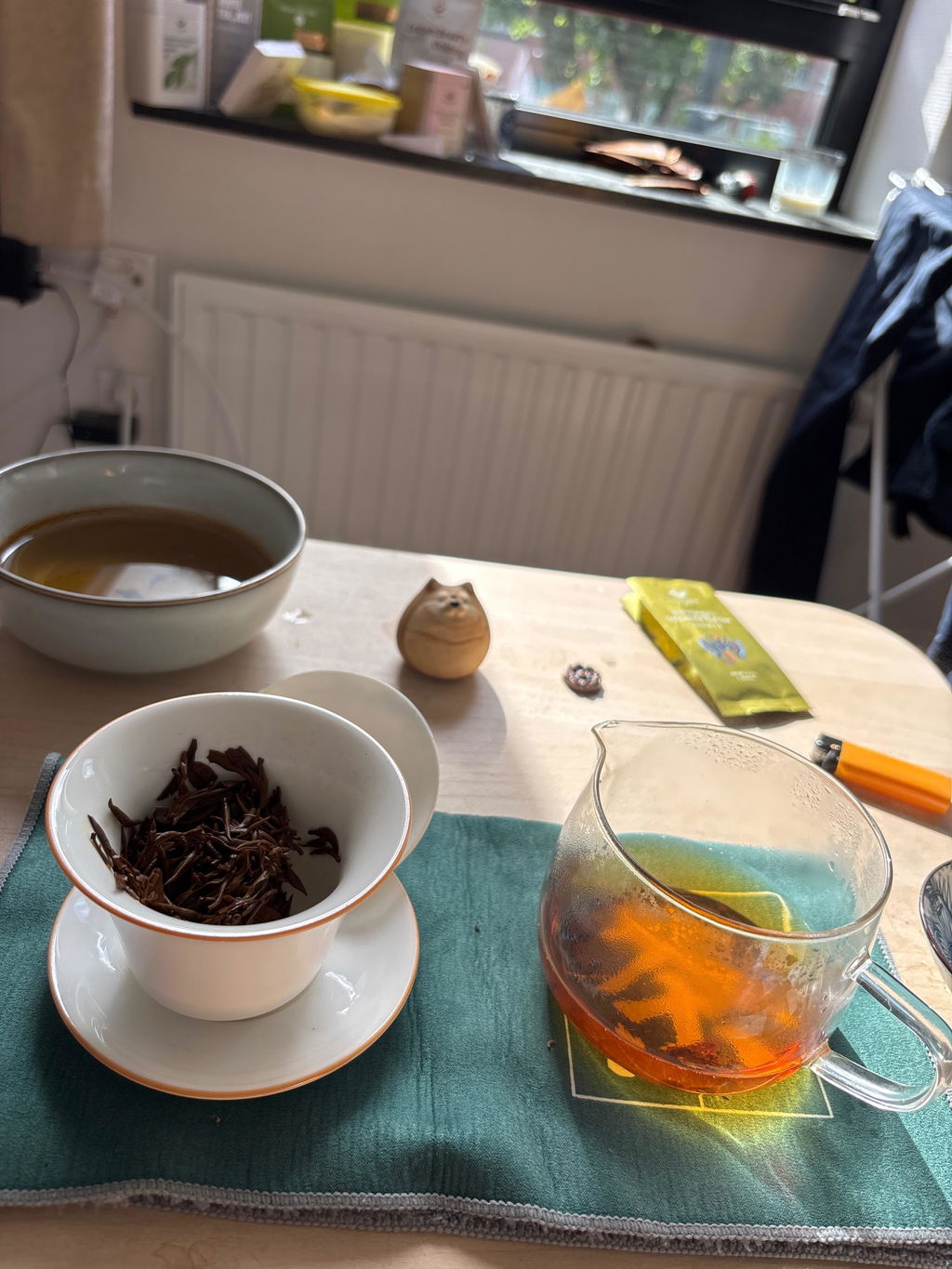
This tea is made with just the buds of the tea plant, maximizing fragrance. These leaves, covered in fine gold hairs called háo 毫, are rolled into fine twists, with the pressure just right to break cell walls inside the leaves and free up aromatic compounds when steeped in hot water. The result is a tea with a lot going on –sweetness, maltiness, floral fragrance, and a fruity pop to the aftertaste.
The result is a super-special red tea that’s worth a gold medal – or two!

Jesse Says:
One of the highlights of my trip to Tea Longevity Mountain was getting to sit next to Mao Laoshi for half an hour as he hand-processed a batch of fresh green teas over a hot wok.
While his hands moved expertly, pushing and rolling the leaves into the wok with practiced motions and delicate pressure, we talked about how tea had changed both of our lives. I felt that we both were people who cared very deeply about doing a thing well – him, making tea, and me, sharing the culture surrounding it.
When I tried his gold medal red tea, I asked if we could include it in our lineup, only to find out that there were only two kilos left. He said that if we waited until next spring, he could make a batch according to our order.
One year after that summer trip to Guizhou, I’m glad to be able to share the tea with you. This is a great tea for drinkers who either have plenty of tea budget or have tried several red teas already and want to try the sort of tea that wins awards in China.
If you want to try it before getting a whole 50g box, I have two packets (10g) of this tea included in my Guizhou Province Sampler.
If you’re here because you did try it and you know you want more, then get it before it runs out, since we likely won’t have any more until next year!
About Guizhou Province & The Tea
Guizhou is one of the most geographically isolated parts of China, as its high mountains and winding valleys make travel beautiful, but difficult.
Guizhou is famous for Maotai liquor, China’s most esteemed Baijiu (rice liquor). The spirit is distilled in Guizhou because of the pristine sources of pure water, unpolluted by industry or large population centers. This same water makes Guizhou’s agricultural products – including tea! – famous all around China.
Cha Shou Shan (Tea Longevity Mountain): A Tea Mountain Time Machine

Cha Shou Shan (Tea Longevity Mountain) is located in an isolated corner of Fenggang Country, Guizhou. The terrain and lack of roads meant that
This isolation meant that in the 1990s, our tea farmer partners were able to preserve an enormous swath of land deep in the forest. They planted tea trees and traditional Chinese medicines, and let them grow without pesticide or pollution, working with local villagers to harvest the leaves once per year in the spring.
The result is a “tea mountain time machine” - the land is even accredited as meeting the Rainforest Alliance’s Sustainable Agricultural Standard. This title is only given if the state of the land is tested scientifically and believed to be as pristine and biodiverse as it would have been 100 years ago.
Three years ago, a new highway opened up connecting Tea Longevity Mountain to Zunyi, cutting travel time to the closest regional airport from nine hours to three hours. In the past few years since the highway opened, our tea farmer partners have built infrastructure to connect the tea farms to the rest of the country – and the world!
We have the honor of being the first Western tea company to share these teas - enjoy a sip of the amazing nature!

Jesse Says:
As the teahouse has grown, I’ve thought a lot about where I can truly add the most value, both to our tea customers, but also to our tea farmers.
I decided that helping share tea from places like Guizhou - well known in China for producing high-quality tea in pristine natural conditions, but almost completely unknown in the West - was a win-win-win situation.
The first win is for our customers, who can get tea that punches above its weight in quality and cleanliness, but without paying for “brand name” tea regions that raise the price in the China market.
The second win is for our farmers, who lack any way of selling directly to Western customers, and need to fight to explain where their tea is from, since very few have heard of their home.
The third win is for me, since I get to go to Guizhou and experience the amazing nature, food, culture, and tea from this fantastic region. Places like Guizhou – wild mountains, fresh food, and diverse ethnic cultures – are my favorite places in China.
This is the first in what I hope to be a series of province-themed tea samplers. I hope you enjoy!

Jesse and the JTH team sourcing tea in Guizhou
You can learn more about Guizhou from our Guizhou blog post!
Try our Guizhou Province Sampler!
Want to try this tea, but also others from the same mountain? Our Guizhou Province tea sampler has this tea along with others!

NOT JUST TEA, TEA CULTURE
Jesse believes the key to making good tea is to help his Chinese tea friends share not just their best teas, but the best ways to make the teas.
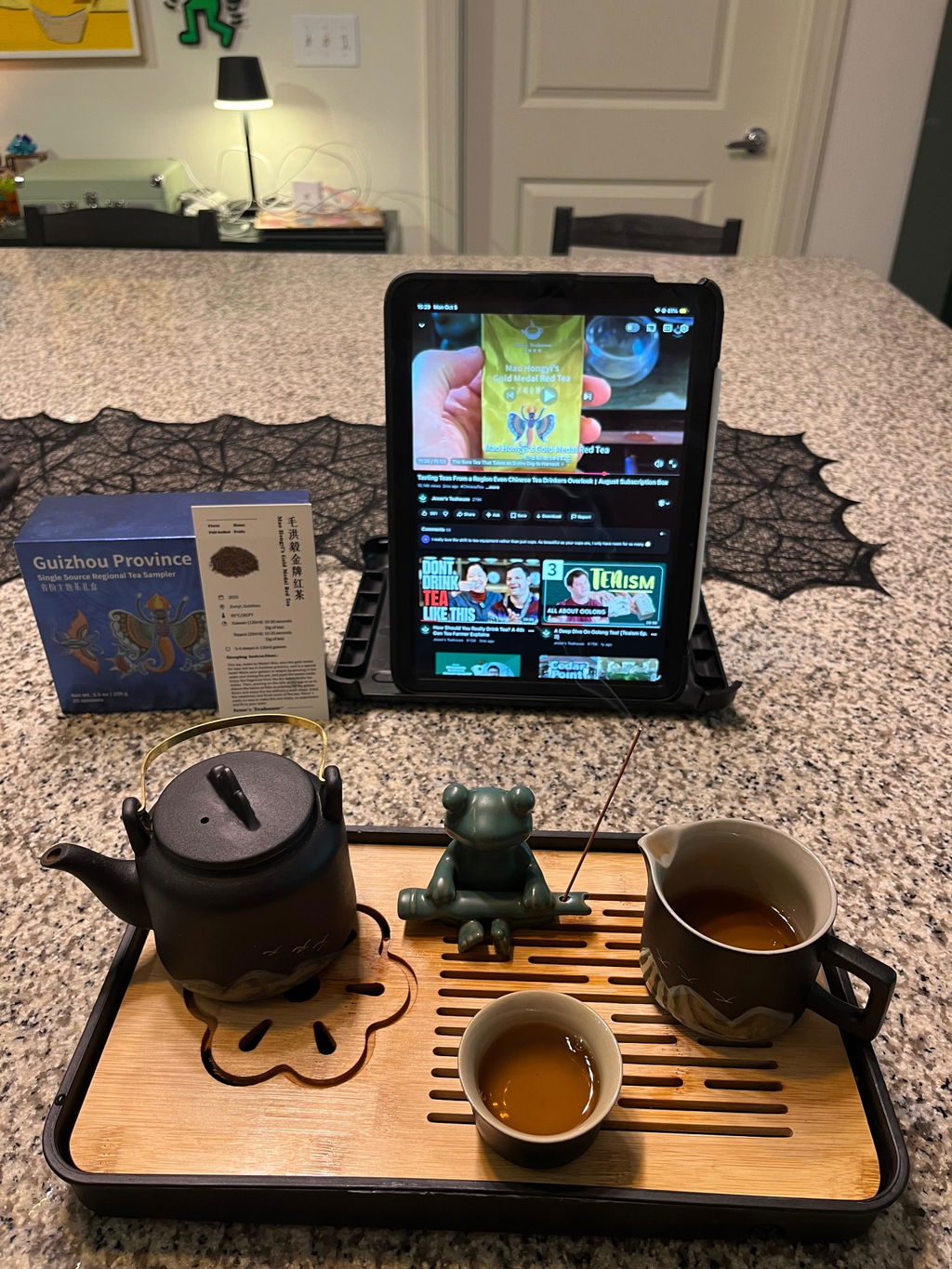
That's why each box comes also comes with an info card that tells you:
- Tea Origin
- Steep Temperature
- Steep Time
- Directions for both teapot steeping and gaiwan steeping
All Jesse’s Teahouse Tea Friends (that’s you now!) also get access to private YouTube videos where Jesse and his Chinese tea friends show you how to make the teas and explain the tea-making process.
The links are on QR codes on the back of the info card included in the tea box.
Mao Hongyi’s Gold Medal Red Tea
What is Red Tea?
What we call "Black Tea" in the West, Chinese call "Red Tea" (Hong Cha 红茶.) It is rich and crisp with a sweet taste and a smoothly tannic aftertaste.
It is an excellent tea for drinkers used to Western tea blends, like Earl Grey or English Breakfast.
Mao Hongyi’s & His Gold Medal Red Tea
Mao Hongyi is the Master tea processor at Tea Longevity Mountain, who is responsible for all the teas in our Guizhou Province Sampler.
Born into a tea family, he learned about tea from his parents, who were tea pickers. After seeing the machinery and techniques of the teamakers who turned the raw tea leaves into delicious tea, he began to study himself, eventually rising to the attention of the team at Tea Longevity Mountain. They put him in charge of the spring tea production line; entrusting the tea mountain’s bounty to his hands.
In 2025, Mao Laoshi took part in a county-wide tea competition. Judges deliver a certain amount of freshly picked leaves to dozens of contestants, who have one day to turn in their teas to a panel of expert judges for blind taste-testing.
Since all the leaves come from the same crop, the differentiating factor is the skill of the tea processor – how long and hard to knead the leaves, how long to ferment them, and the hand-processing skill of slowly removing moisture using a heated wok.
Mao Laoshi’s skill won him first prize in the competition – best in Fenggang County. The next year, in 2026, he used the same timings and techniques to create a batch of the tea just for us.
This tea is made with just the buds of the tea plant, maximizing fragrance. These leaves, covered in fine gold hairs called háo 毫, are rolled into fine twists, with the pressure just right to break cell walls inside the leaves and free up aromatic compounds when steeped in hot water. The result is a tea with a lot going on –sweetness, maltiness, floral fragrance, and a fruity pop to the aftertaste.
The result is a super-special red tea that’s worth a gold medal – or two!
Jesse Says:
One of the highlights of my trip to Tea Longevity Mountain was getting to sit next to Mao Laoshi for half an hour as he hand-processed a batch of fresh green teas over a hot wok.
While his hands moved expertly, pushing and rolling the leaves into the wok with practiced motions and delicate pressure, we talked about how tea had changed both of our lives. I felt that we both were people who cared very deeply about doing a thing well – him, making tea, and me, sharing the culture surrounding it.
When I tried his gold medal red tea, I asked if we could include it in our lineup, only to find out that there were only two kilos left. He said that if we waited until next spring, he could make a batch according to our order.
One year after that summer trip to Guizhou, I’m glad to be able to share the tea with you. This is a great tea for drinkers who either have plenty of tea budget or have tried several red teas already and want to try the sort of tea that wins awards in China.
If you want to try it before getting a whole 50g box, I have two packets (10g) of this tea included in my Guizhou Province Sampler.
If you’re here because you did try it and you know you want more, then get it before it runs out, since we likely won’t have any more until next year!
About Guizhou Province & The Tea
Guizhou is one of the most geographically isolated parts of China, as its high mountains and winding valleys make travel beautiful, but difficult.
Guizhou is famous for Maotai liquor, China’s most esteemed Baijiu (rice liquor). The spirit is distilled in Guizhou because of the pristine sources of pure water, unpolluted by industry or large population centers. This same water makes Guizhou’s agricultural products – including tea! – famous all around China.
Cha Shou Shan (Tea Longevity Mountain): A Tea Mountain Time Machine
Cha Shou Shan (Tea Longevity Mountain) is located in an isolated corner of Fenggang Country, Guizhou. The terrain and lack of roads meant that
This isolation meant that in the 1990s, our tea farmer partners were able to preserve an enormous swath of land deep in the forest. They planted tea trees and traditional Chinese medicines, and let them grow without pesticide or pollution, working with local villagers to harvest the leaves once per year in the spring.
The result is a “tea mountain time machine” - the land is even accredited as meeting the Rainforest Alliance’s Sustainable Agricultural Standard. This title is only given if the state of the land is tested scientifically and believed to be as pristine and biodiverse as it would have been 100 years ago.
Three years ago, a new highway opened up connecting Tea Longevity Mountain to Zunyi, cutting travel time to the closest regional airport from nine hours to three hours. In the past few years since the highway opened, our tea farmer partners have built infrastructure to connect the tea farms to the rest of the country – and the world!
We have the honor of being the first Western tea company to share these teas - enjoy a sip of the amazing nature!
Jesse Says:
As the teahouse has grown, I’ve thought a lot about where I can truly add the most value, both to our tea customers, but also to our tea farmers.
I decided that helping share tea from places like Guizhou - well known in China for producing high-quality tea in pristine natural conditions, but almost completely unknown in the West - was a win-win-win situation.
The first win is for our customers, who can get tea that punches above its weight in quality and cleanliness, but without paying for “brand name” tea regions that raise the price in the China market.
The second win is for our farmers, who lack any way of selling directly to Western customers, and need to fight to explain where their tea is from, since very few have heard of their home.
The third win is for me, since I get to go to Guizhou and experience the amazing nature, food, culture, and tea from this fantastic region. Places like Guizhou – wild mountains, fresh food, and diverse ethnic cultures – are my favorite places in China.
This is the first in what I hope to be a series of province-themed tea samplers. I hope you enjoy!
Jesse and the JTH team sourcing tea in Guizhou
You can learn more about Guizhou from our Guizhou blog post!
Try our Guizhou Province Sampler!
Want to try this tea, but also others from the same mountain? Our Guizhou Province tea sampler has this tea along with others!
NOT JUST TEA, TEA CULTURE
Jesse believes the key to making good tea is to help his Chinese tea friends share not just their best teas, but the best ways to make the teas.
That's why each box comes also comes with an info card that tells you:
- Tea Origin
- Steep Temperature
- Steep Time
- Directions for both teapot steeping and gaiwan steeping
All Jesse’s Teahouse Tea Friends (that’s you now!) also get access to private YouTube videos where Jesse and his Chinese tea friends show you how to make the teas and explain the tea-making process.
The links are on QR codes on the back of the info card included in the tea box.
Mao Hongyi’s Gold Medal Red Tea
What is Red Tea?
What we call "Black Tea" in the West, Chinese call "Red Tea" (Hong Cha 红茶.) It is rich and crisp with a sweet taste and a smoothly tannic aftertaste.
It is an excellent tea for drinkers used to Western tea blends, like Earl Grey or English Breakfast.
Mao Hongyi’s & His Gold Medal Red Tea
Mao Hongyi is the Master tea processor at Tea Longevity Mountain, who is responsible for all the teas in our Guizhou Province Sampler.
Born into a tea family, he learned about tea from his parents, who were tea pickers. After seeing the machinery and techniques of the teamakers who turned the raw tea leaves into delicious tea, he began to study himself, eventually rising to the attention of the team at Tea Longevity Mountain. They put him in charge of the spring tea production line; entrusting the tea mountain’s bounty to his hands.
In 2025, Mao Laoshi took part in a county-wide tea competition. Judges deliver a certain amount of freshly picked leaves to dozens of contestants, who have one day to turn in their teas to a panel of expert judges for blind taste-testing.
Since all the leaves come from the same crop, the differentiating factor is the skill of the tea processor – how long and hard to knead the leaves, how long to ferment them, and the hand-processing skill of slowly removing moisture using a heated wok.
Mao Laoshi’s skill won him first prize in the competition – best in Fenggang County. The next year, in 2026, he used the same timings and techniques to create a batch of the tea just for us.
This tea is made with just the buds of the tea plant, maximizing fragrance. These leaves, covered in fine gold hairs called háo 毫, are rolled into fine twists, with the pressure just right to break cell walls inside the leaves and free up aromatic compounds when steeped in hot water. The result is a tea with a lot going on –sweetness, maltiness, floral fragrance, and a fruity pop to the aftertaste.
The result is a super-special red tea that’s worth a gold medal – or two!
Jesse Says:
One of the highlights of my trip to Tea Longevity Mountain was getting to sit next to Mao Laoshi for half an hour as he hand-processed a batch of fresh green teas over a hot wok.
While his hands moved expertly, pushing and rolling the leaves into the wok with practiced motions and delicate pressure, we talked about how tea had changed both of our lives. I felt that we both were people who cared very deeply about doing a thing well – him, making tea, and me, sharing the culture surrounding it.
When I tried his gold medal red tea, I asked if we could include it in our lineup, only to find out that there were only two kilos left. He said that if we waited until next spring, he could make a batch according to our order.
One year after that summer trip to Guizhou, I’m glad to be able to share the tea with you. This is a great tea for drinkers who either have plenty of tea budget or have tried several red teas already and want to try the sort of tea that wins awards in China.
If you want to try it before getting a whole 50g box, I have two packets (10g) of this tea included in my Guizhou Province Sampler.
If you’re here because you did try it and you know you want more, then get it before it runs out, since we likely won’t have any more until next year!
About Guizhou Province & The Tea
Guizhou is one of the most geographically isolated parts of China, as its high mountains and winding valleys make travel beautiful, but difficult.
Guizhou is famous for Maotai liquor, China’s most esteemed Baijiu (rice liquor). The spirit is distilled in Guizhou because of the pristine sources of pure water, unpolluted by industry or large population centers. This same water makes Guizhou’s agricultural products – including tea! – famous all around China.
Cha Shou Shan (Tea Longevity Mountain): A Tea Mountain Time Machine
Cha Shou Shan (Tea Longevity Mountain) is located in an isolated corner of Fenggang Country, Guizhou. The terrain and lack of roads meant that
This isolation meant that in the 1990s, our tea farmer partners were able to preserve an enormous swath of land deep in the forest. They planted tea trees and traditional Chinese medicines, and let them grow without pesticide or pollution, working with local villagers to harvest the leaves once per year in the spring.
The result is a “tea mountain time machine” - the land is even accredited as meeting the Rainforest Alliance’s Sustainable Agricultural Standard. This title is only given if the state of the land is tested scientifically and believed to be as pristine and biodiverse as it would have been 100 years ago.
Three years ago, a new highway opened up connecting Tea Longevity Mountain to Zunyi, cutting travel time to the closest regional airport from nine hours to three hours. In the past few years since the highway opened, our tea farmer partners have built infrastructure to connect the tea farms to the rest of the country – and the world!
We have the honor of being the first Western tea company to share these teas - enjoy a sip of the amazing nature!
Jesse Says:
As the teahouse has grown, I’ve thought a lot about where I can truly add the most value, both to our tea customers, but also to our tea farmers.
I decided that helping share tea from places like Guizhou - well known in China for producing high-quality tea in pristine natural conditions, but almost completely unknown in the West - was a win-win-win situation.
The first win is for our customers, who can get tea that punches above its weight in quality and cleanliness, but without paying for “brand name” tea regions that raise the price in the China market.
The second win is for our farmers, who lack any way of selling directly to Western customers, and need to fight to explain where their tea is from, since very few have heard of their home.
The third win is for me, since I get to go to Guizhou and experience the amazing nature, food, culture, and tea from this fantastic region. Places like Guizhou – wild mountains, fresh food, and diverse ethnic cultures – are my favorite places in China.
This is the first in what I hope to be a series of province-themed tea samplers. I hope you enjoy!
Jesse and the JTH team sourcing tea in Guizhou
You can learn more about Guizhou from our Guizhou blog post!
Try our Guizhou Province Sampler!
Want to try this tea, but also others from the same mountain? Our Guizhou Province tea sampler has this tea along with others!
NOT JUST TEA, TEA CULTURE
Jesse believes the key to making good tea is to help his Chinese tea friends share not just their best teas, but the best ways to make the teas.
That's why each box comes also comes with an info card that tells you:
- Tea Origin
- Steep Temperature
- Steep Time
- Directions for both teapot steeping and gaiwan steeping
All Jesse’s Teahouse Tea Friends (that’s you now!) also get access to private YouTube videos where Jesse and his Chinese tea friends show you how to make the teas and explain the tea-making process.
The links are on QR codes on the back of the info card included in the tea box.
Mao Hongyi’s Gold Medal Red Tea
What is Red Tea?
What we call "Black Tea" in the West, Chinese call "Red Tea" (Hong Cha 红茶.) It is rich and crisp with a sweet taste and a smoothly tannic aftertaste.
It is an excellent tea for drinkers used to Western tea blends, like Earl Grey or English Breakfast.
Mao Hongyi’s & His Gold Medal Red Tea
Mao Hongyi is the Master tea processor at Tea Longevity Mountain, who is responsible for all the teas in our Guizhou Province Sampler.
Born into a tea family, he learned about tea from his parents, who were tea pickers. After seeing the machinery and techniques of the teamakers who turned the raw tea leaves into delicious tea, he began to study himself, eventually rising to the attention of the team at Tea Longevity Mountain. They put him in charge of the spring tea production line; entrusting the tea mountain’s bounty to his hands.
In 2025, Mao Laoshi took part in a county-wide tea competition. Judges deliver a certain amount of freshly picked leaves to dozens of contestants, who have one day to turn in their teas to a panel of expert judges for blind taste-testing.
Since all the leaves come from the same crop, the differentiating factor is the skill of the tea processor – how long and hard to knead the leaves, how long to ferment them, and the hand-processing skill of slowly removing moisture using a heated wok.
Mao Laoshi’s skill won him first prize in the competition – best in Fenggang County. The next year, in 2026, he used the same timings and techniques to create a batch of the tea just for us.
This tea is made with just the buds of the tea plant, maximizing fragrance. These leaves, covered in fine gold hairs called háo 毫, are rolled into fine twists, with the pressure just right to break cell walls inside the leaves and free up aromatic compounds when steeped in hot water. The result is a tea with a lot going on –sweetness, maltiness, floral fragrance, and a fruity pop to the aftertaste.
The result is a super-special red tea that’s worth a gold medal – or two!
Jesse Says:
One of the highlights of my trip to Tea Longevity Mountain was getting to sit next to Mao Laoshi for half an hour as he hand-processed a batch of fresh green teas over a hot wok.
While his hands moved expertly, pushing and rolling the leaves into the wok with practiced motions and delicate pressure, we talked about how tea had changed both of our lives. I felt that we both were people who cared very deeply about doing a thing well – him, making tea, and me, sharing the culture surrounding it.
When I tried his gold medal red tea, I asked if we could include it in our lineup, only to find out that there were only two kilos left. He said that if we waited until next spring, he could make a batch according to our order.
One year after that summer trip to Guizhou, I’m glad to be able to share the tea with you. This is a great tea for drinkers who either have plenty of tea budget or have tried several red teas already and want to try the sort of tea that wins awards in China.
If you want to try it before getting a whole 50g box, I have two packets (10g) of this tea included in my Guizhou Province Sampler.
If you’re here because you did try it and you know you want more, then get it before it runs out, since we likely won’t have any more until next year!
About Guizhou Province & The Tea
Guizhou is one of the most geographically isolated parts of China, as its high mountains and winding valleys make travel beautiful, but difficult.
Guizhou is famous for Maotai liquor, China’s most esteemed Baijiu (rice liquor). The spirit is distilled in Guizhou because of the pristine sources of pure water, unpolluted by industry or large population centers. This same water makes Guizhou’s agricultural products – including tea! – famous all around China.
Cha Shou Shan (Tea Longevity Mountain): A Tea Mountain Time Machine
Cha Shou Shan (Tea Longevity Mountain) is located in an isolated corner of Fenggang Country, Guizhou. The terrain and lack of roads meant that
This isolation meant that in the 1990s, our tea farmer partners were able to preserve an enormous swath of land deep in the forest. They planted tea trees and traditional Chinese medicines, and let them grow without pesticide or pollution, working with local villagers to harvest the leaves once per year in the spring.
The result is a “tea mountain time machine” - the land is even accredited as meeting the Rainforest Alliance’s Sustainable Agricultural Standard. This title is only given if the state of the land is tested scientifically and believed to be as pristine and biodiverse as it would have been 100 years ago.
Three years ago, a new highway opened up connecting Tea Longevity Mountain to Zunyi, cutting travel time to the closest regional airport from nine hours to three hours. In the past few years since the highway opened, our tea farmer partners have built infrastructure to connect the tea farms to the rest of the country – and the world!
We have the honor of being the first Western tea company to share these teas - enjoy a sip of the amazing nature!
Jesse Says:
As the teahouse has grown, I’ve thought a lot about where I can truly add the most value, both to our tea customers, but also to our tea farmers.
I decided that helping share tea from places like Guizhou - well known in China for producing high-quality tea in pristine natural conditions, but almost completely unknown in the West - was a win-win-win situation.
The first win is for our customers, who can get tea that punches above its weight in quality and cleanliness, but without paying for “brand name” tea regions that raise the price in the China market.
The second win is for our farmers, who lack any way of selling directly to Western customers, and need to fight to explain where their tea is from, since very few have heard of their home.
The third win is for me, since I get to go to Guizhou and experience the amazing nature, food, culture, and tea from this fantastic region. Places like Guizhou – wild mountains, fresh food, and diverse ethnic cultures – are my favorite places in China.
This is the first in what I hope to be a series of province-themed tea samplers. I hope you enjoy!
Jesse and the JTH team sourcing tea in Guizhou
You can learn more about Guizhou from our Guizhou blog post!
Try our Guizhou Province Sampler!
Want to try this tea, but also others from the same mountain? Our Guizhou Province tea sampler has this tea along with others!
NOT JUST TEA, TEA CULTURE
Jesse believes the key to making good tea is to help his Chinese tea friends share not just their best teas, but the best ways to make the teas.
That's why each box comes also comes with an info card that tells you:
- Tea Origin
- Steep Temperature
- Steep Time
- Directions for both teapot steeping and gaiwan steeping
All Jesse’s Teahouse Tea Friends (that’s you now!) also get access to private YouTube videos where Jesse and his Chinese tea friends show you how to make the teas and explain the tea-making process.
The links are on QR codes on the back of the info card included in the tea box.